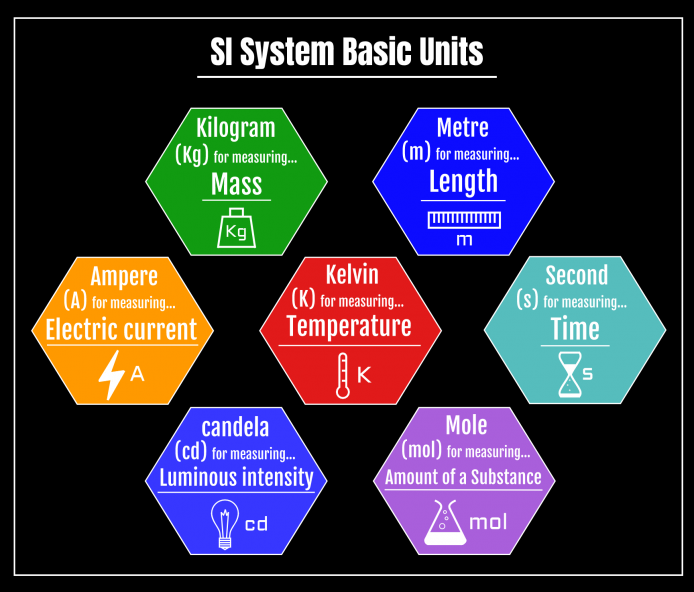
Another common unit to measure molecular mass is the Dalton (Da), which is defined as the mass of one hydrogen atom. This is commonly used in biology to describe the masses of amino acids and proteins. For example a protein with a molecular weight of 36,000 g mol-1, has a mass of 36,000 daltons, or 36 kDa.We also have other units that are defined in terms of these basic units, such as:
We can often work out what the units for a physical quantity are by looking at the at the equation to calculate them. For example, speed is calculated as:\[\text{speed} = \frac{\text{distance}}{\text{time}} \sim \frac{\text{metres}}{\text{seconds}}\]So the units for speed are metres divided by seconds, or m/s. We could also write it as metres multiplied by seconds-1, or ms-1. We pronounce m/s, as metres per second. In general, whenever you see a "/" in a unit, you can replace it with "per".Similarly, we can calculate acceleration:\[\text{acceleration} = \frac{\text{speed}}{\text{time}} = \frac{\frac{\text{distance}}{\text{time}}}{\text{time}} = \frac{\text{distance}}{\text{time}^2} \sim \frac{\text{metres}}{\text{seconds}^2}\]Hence, acceleration is measured in metres divided by seconds2, or m/s2. Again, we could write it as metres multiplied by seconds-2, or ms-2. Or we could just say metres per second2, or metres per second per second.We often want to measure quantities that would give really big or really small numbers if we used the standard units for that quantity. Therefore it's convenient to have a system of prefixes that defines units of different orders of magnitude of the same unit, such as millimetres, centimetres, metres, kilometres etc.
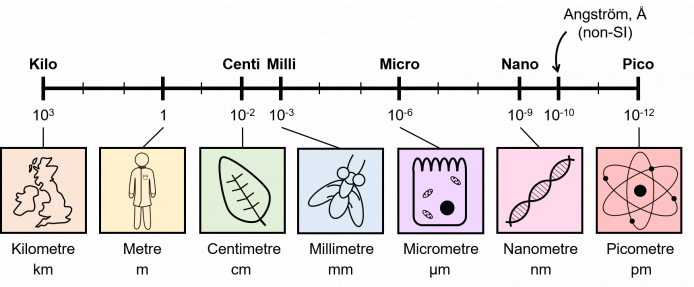
| Prefix | Multiplied by | Symbol |
|---|---|---|
| exa | \(10^{18}\) | E |
| peta | \(10^{15}\) | P |
| tera | \(10^{12}\) | T |
| giga | \(10^{9}\) | G |
| mega | \(10^6\) | M |
| kilo | \(10^3\) | k |
| hecto | \(10^2\) | h |
| deca | \(10\) | dk |
| deci | \(10^{-1}\) | d |
| centi | \(10^{-2}\) | c |
| milli | \(10^{-3}\) | m |
| micro | \(10^{-6}\) | \(\mu\) |
| nano | \(10^{-9}\) | n |
| pico | \(10^{-12}\) | p |
| femto | \(10^{-15}\) | f |
| atto | \(10^{-18}\) | a |
The table above shows the standard SI prefixes, along with the factor that you have to multiply the standard units by, and their symbols. For example, there are \(10^9\) metres in a gigametre, and a gigametre is denoted by Gm.To move up the table, you normally divide by \(10^3(=1000)\), and to move down the table you normally multiply by \(10^3(=1000)\). For example, to convert millimetres to metres, you divide by \(1000\), and to convert metres back to millimetres, you multiply by \(1000\). Note: This rule doesn't work to convert between hecto, deca, deci, or centi.
]]>Dimensions are not the same as units, for example we can measure speed in metres per second, kilometres per hour, or miles per hour; but it is always a length divided by a time regardless of the units, so the dimensions of speed are L/T.Similarly, we can measure area as square metres, or square kilometres, or square miles, but it is always a length squared, so the dimensions of area are L2.We can use this to work out the units of a constant or variable in an equation, by substituting the dimensions of the variables into the equation. This is based on the principle of consistency of dimensions, if two expressions are equal, their dimensions must be the same.Notation: To denote the dimensions of a physical quantity \(X\), we use square brackets, \([X]\).
]]>We know that force is mass times acceleration, \(F = ma\), so we can write the dimensions of force as \(\color{blue}{[F] = [m][a] = M L T^{-2}}\) since acceleration is a length divided by a time squared. We also have the dimensions of speed as a length over a time, \(\color{red}{[v] = L/T = LT^{-1}}\).
So now we can put this into our original equation:\[\color{blue}{MLT^{-2}} =[k](\color{red}{LT^{-1}})^2 = [k]L^2T^{-2}\]Now we rearrange to find \([k]\).\[\begin{align} [k] &= \frac{MLT^{-2}}{L^2T^{-2}} \\ &= \frac{ML}{L^2}\\ &=\frac{M}L \end{align}\]So we now that \(k\) is a mass divided by a length, or we can measure it in terms of kg/m.
]]>It's helpful to write down all the dimensions we know:
We can now substitute all of these into the equation, noting that we can ignore the dimensions of \(-2\pi\) since that's just a number that has no dimensions.\[\begin{align} \color{blue}{MLT^{-2}} &= \color{red}L \color{green}L \frac{\color{purple}{LT^{-1}}}{\color{orange}L}[\eta] \\ &= L^2T^{-1}[\eta] \\ MT^{-2} &= LT^{-1}[\eta] \\ L[\eta] &= MT^{-1} \\ [\eta] &= ML^{-1}T^{-1} \end{align}\]So we have that the dimensions of viscosity are a mass divided by a length and a time, so we can measure it in kgm-1s-1.
]]>Suppose that \(v\) is proportional to some power of \(l\), that \[v \propto l^a\]Use dimensional arguments to find \(a\).
Since \(v\) depends on \(l\) and \(g\), we can write\[v = Cl^a g^b\]for some dimensionless constant \(C\). Now taking dimensions gives us\[LT^{-1} = L^a(LT^{-2})^b = L^{a + b}T^{-2b}\]since \(g\) is an acceleration due to gravity. Matching the dimensions yields\[1 = a+ b \\ -1 = -2b\]which can be solved to give\[b = \frac12 \\ a = \frac12\](So this gives \(v \propto \sqrt{gl}\).)
]]>Taking dimensions of the equation gives us\[T = M^a(ML^{-3})^b(L^2T^{-1})^c = M^{a+b}L^{-3b+2c}T^{-c}\]which yields the equations\[1 = -c \\ 0 = a + b \\ 0 = -3b+2c\]Solving these simultaneously gives us\[a = \frac23 \\ b =-\frac23 \\ c = -1\]So then\[t = Cm^{\frac23}\rho^{-\frac23}\kappa^{-1} \propto m^{\frac23}\rho^{-\frac23}\kappa^{-1}\]
]]>Based on the observation that the terminal velocity \(v\) is proportional to the powder density, express \(v\) in terms of \(\rho\), \(g\), \(d\), and \(\eta\) using dimensional analysis.
]]>So now we have\[LT^{-1}= M^{1+z}L^{x+y+z-3}T^{-2x-z}\]
Matching the LHS and RHS dimensions yields\[z=-1 \\ x+ y - z - 3 = 1 \\ -2x+1 = -1\]Solving the simultaneous equations yields\[x=1 \\y=2\\z=-1\]
Thus we obtain \[v = \Gamma\rho g d^2\eta^{-1}\]
Experiments show that \(R\) is proportional to the length of the blood vessel \(L\) (m). Use dimensional analysis to show that \(R\) is expressed in terms of \(L\), the viscosity of blood (Pa s), and the radius of the blood vessel \(r\) (m) in the following form:
\[R = \Gamma \frac{L\eta}{r^4}\]
where \(\Gamma\) is a dimensionless constant.
]]>Charged molecules (each with charge \(q\) [C=coulomb]) travel through the electric field \(E\) (N C-1). Each molecules experience frictional drag \(f\) (N s m-1).
Calculate the speed \(v\) of the molecule.
(a) Express the flight time \(t\) (s) in terms of mass of the ion \(m\) (kg), charge of the ion \(q\) (C = coulomb), the electrostatic potential \(\varepsilon\) (J C-1), and the length of flight \(L\).
(b) Express the speed of the ion \(v\) in terms of the mass \(m\), charge \(q\) and the electrostatic potential \(\varepsilon\).
(c) Does your answer make sense?
]]>
The exercises below will train you all the mathematical skills required to understand and practice linearisation.
]]>
These exercises will use logarithms, if you need a refresher before you attempt these problems, we encourage you to look at the Exponentials and Logarithms section of the Maths Survival Skills webpage.
]]>Take the natural logarithm on both sides,\[\ln(y)=\ln(2e^{-3x})\]Then simplify\[\ln(y)=\ln(2) -3x\]Now we can sketch a linear graph using
]]>
Important note: If you use \(x\) as the independent variable, you don’t get a linear plot. You have to use \(\frac{1}{x}\).
]]>Take the natural logarithm on both sides,\[\ln(y)=\ln(2e^{\frac{3}{x}})\]Then simplify\[\ln(y)=\ln(2) +3\frac{1}{x}\]Now we can sketch a linear graph using
]]>
Linearise \[k=Ae^{-\frac{E_a}{RT}}\]And sketch the linearised graph
You change \(T\) and measure \(k\) experimentally. \(E_a\) is the activation energy you want to get from the Arrhenius equation.
]]>Linearise \[k=Ae^{-\frac{E_a}{RT}}\]
And sketch the linearised graph
You change \(T\) and measure \(k\) experimentally. \(E_a\) is the activation energy you want to get from the Arrhenius equation.
\(k\): rate constant, \(R\): gas constant, \(E_a\): activation energy, \(A\): pre-exponential factor (representing, for example, collision), \(T\): temperature.
This exercise is similar to Exercise 2, as x is called T and 3 is now \(\frac{E_a}{R}\)
Take the natural logarithm on both sides,
\[\ln(k)=\ln\left(Ae^{-\frac{E_a}{RT}}\right)\]Then simplify\[\ln(k)=\ln\left(A\right) -\frac{E_a}{R}\frac{1}{T}\]Now we can sketch a linear graph using
]]>
Divide both sides by \(x\)
\[y = 2\frac{1}{x}-3\]Now we can sketch a linear graph using
This looks like a very strange question. But you will see the same approach will be used in Exercise 5
]]>\(\Delta H\) and \(\Delta S\) are constants, but \(K\) changes with \(T\).
]]>And sketch the linearised graph
where \(\Delta H\) and \(\Delta S\) are constants, but K changes with T
This exercise is similar to Exercise 4.
Divide both sides by T
\[-R\ln(K) = \Delta H\frac{1}{T}- \Delta S\]Now we can sketch a linear graph using
]]>
Experimentally, measure \(K\) at different temperatures. Plotting them on a van’t Hoff plot will give you \(\Delta H\) and \(\Delta S\) if neither of them change with temperature.
]]>Divide both sides by y and then multiply both sides by 2x+5
\[\frac{1}{y} = 2x+5\]Now we can sketch a linear graph using
]]>
Sketch the linearised graph
]]>
Sketch the linearised graph
This exercise is similar to Exercise 6.
Rearranging gives
\[\frac{1}{[A]}=kt+\frac{1}{[A]_0}\]Now we can sketch a linear graph using
This is the linearised plot for the second-order rate equation.
]]>Return to Subject Applications
]]>
The exercises below will use logarithms. If you need a refresher before you attempt these problems, we encourage you to look at the Exponentials and Logarithms section of the Maths 'Survival' Skills webpage.
]]>Solution
Take the natural logarithm on both sides\[\ln(y)=\ln(e^{-x})\]Then simplify
\[\ln(y)=-x\]
]]>Solution
Take the natural logarithm on both sides\[\ln(y)=\ln(e^{-2x})\]Then simplify
\[\ln(y)=-2x\]
]]>Solution
Take the natural logarithm on both sides\[\ln(y)=\ln(e^{-\frac{x}{2}})\]Then simplify
\[\ln(y)=-\frac{x}{2}\]
]]>Solution
Take the natural logarithm on both sides\[\ln(y)=\ln\left(\frac{e^{-x}}{2}\right)\]Then simplify\[\ln(y)=\ln(e^{-x})-\ln(2)\]
\[\ln(y)=-x-\ln(2)\]
]]>Solution
Take the natural logarithm on both sides\[\ln(y)=\ln\left(\frac{3}{2}e^{-x}\right)\]Then simplify\[\ln(y)=\ln(e^{-x})+\ln(\frac{3}{2})\]
\[\ln(y)=-x+\ln(\frac{3}{2})\]
]]>Solution
This question is very similar to the one in Exercise 3, think of E as x and RT as 2 in that instance.
Take the natural logarithm on both sides\[\ln(y)=\ln(e^{-\frac{E}{RT}})\]Then simplify
\[\ln(y)=-\frac{E}{RT}\]
]]>Solution
This question is similar to Exercise 5 where g(E) acts the same way as \(\frac{3}{2}\).
Take the natural logarithm on both sides\[\ln(y)=\ln(g(E)e^{-\frac{E}{RT}})\]Then simplify\[\ln(y)=\ln(e^{-\frac{E}{RT}})+\ln(g(E))\]
\[\ln(y)=-\frac{E}{RT} +\ln(g(E))\]
]]>Solution
This question still uses the same technique as all the previous parts, we have just replaced \(y\) with \(K\).
Take the natural logarithm on both sides\[\ln(K)=\ln(e^{-\frac{\Delta H}{RT}})\]Then simplify
\[\ln(K)=-\frac{\Delta H}{RT}\]
]]>Solution
This exercise is similar to Exercise 5 and 7, go back and have a look at them if you are struggling with this question.
Take the natural logarithm on both sides\[\ln(K)=\ln\left(\frac{W_f}{W_i}e^{-\frac{\Delta H}{RT}}\right)\]Then simplify\[\ln(K)=\ln\left(e^{-\frac{\Delta H}{RT}}\right)+ \ln\left(\frac{W_f}{W_i}\right)\]
\[\ln(K)=-\frac{\Delta H}{RT}+ \ln\left(\frac{W_f}{W_i}\right)\]This equation shows the important contributions for the equilibrium constant. The enthalpy gap \(\Delta H\) and the numbers of initial and final states.
]]>Where \(\Delta H\) is enthalpy change, \(\Delta H = H_f-H_i\), \(W_i \) and \(W_f\) are the number of configurations of the initial and final states respectively and \(\Delta S\) is entropy change.
]]>
Where \(\Delta H\) is enthalpy change, \(\Delta H = H_f-H_i\), \(W_i \) and \(W_f\) are the number of configurations of the initial and final states respectively and \(\Delta S\) is entropy change.
Solution
Take the natural logarithm on both sides\[\ln(K)=\ln\left(\frac{W_f}{W_i}e^{-\frac{\Delta H}{RT}}\right)\]Then simplify\[\ln(K)=\ln\left(e^{-\frac{\Delta H}{RT}}\right)+ \ln\left(\frac{W_f}{W_i}\right)\]
\[\ln(K)=-\frac{\Delta H}{RT}+ \ln\left(\frac{W_f}{W_i}\right)\]Multiply both sides by \(RT\) \[-RT\ln(K)=\Delta H-RT \color{blue}{\ln\left(\frac{W_f}{W_i}\right)}\]Rearrange the equation for \(\Delta S\) and substitute it in\[\color{blue}{\frac{\Delta S}{R} = \ln\left(\frac{W_f}{W_i} \right)}\]\[-RT\ln(K)=\Delta H-RT \color{blue}{\frac{\Delta S}{R}}\]Cancel out R from the last term to obtain the final answer\[-RT\ln(K) = \Delta H- T\Delta S\]This is a very important equation relating the equilibrium constant to the Gibbs free energy \[\Delta G \equiv \Delta H – T \Delta S\]
]]>Return to Subject Applications
]]>
.png')
Time series plot: Standard format for plotting data where your dependent variable is numerical and your independent variable is time. You may need to fit your data with an equation to quantify the rate at which the dependent variable changes in time.
.png')
XY scatter plot: Typical format for plotting data where dependent and independent variables are both numerical, and you want to show how two variables may be related to one another. You may need to fit your data with an equation to quantify the relationship between the two variables.
.png')
| Amount of protein (\(\mu g\)) | Absorbance at 562 nm |
|---|---|
| 0 | 0.094 |
| 1.25 | 0.182 |
| 6.25 | 0.258 |
| 12.5 | 0.474 |
| 25 | 0.783 |
| 37.5 | 1.009 |
| 50 | 1.44 |
| 75 | 1.801 |
It’s not necessary to plot the data to answer this question, you simply have to write down what variables are plotted on the \(x\) and \(y\) axes.
]]>
]]>| Time (min) | Absorbance at 600 nm |
|---|---|
| 0 | 0.0561 |
| 70 | 0.135 |
| 102 | 0.329 |
| 160 | 1.168 |
| 192 | 2.64 |
| 225 | 3.62 |
| 260 | 4.54 |
| 290 | 5.12 |
| 325 | 6.2 |
| 360 | 6.5 |
| 395 | 6.76 |
| 440 | 6.94 |
| 490 | 7.06 |
| 560 | 7.24 |
It’s not necessary to plot the data to answer this question, you simply have to write down what variables are plotted on the \(x\) and \(y\) axes.
]]>
]]>It’s not necessary to plot the data to answer this question, you simply have to write down what variables are plotted on the \(x\) and \(y\) axes.
]]>
The independent variable here is the concentration of specific ligand (\([\text{L}]\)), therefore this data should be plotted on the \(x\)-axis. The fractional saturation (\(\text{[PL]}/[\text{P}_{\text{total}}]\)) is the dependent variable that you have measured and should be plotted on the \(y\)-axis.
The other parameter in the equation is the equilibrium association constant (\(K_a\)) which is a constant. You want to determine a value for this parameter by fitting your plotted data with the following equation: \[\frac{\text{[PL]}}{[\text{P}_{\text{total}}]} = \frac{K_a\text{[L]}}{1 + K_a\text{[L]}}\]
(FYI: This data fitting could be done in R using non-linear regression). Please see the ‘Graphical answer’ tab for an example of how this data might be plotted.
]]>It’s not necessary to plot the data to answer this question, you simply have to write down what variables are plotted on the \(x\) and \(y\) axes.
]]>
The independent variable here is time in seconds, therefore this data should be plotted on the \(x\)-axis. You should not worry that the equation has the time variable (\(=t\)) in the exponential term. The absorbance at 405 nm is the dependent variable that you have measured to monitor progression of the reaction and should be plotted on the \(y\)-axis.
The other parameters in the equation are the \(b\) and \(c\) terms, and pseudo-first order rate constant (\(k_{\text{obs}}\)), all of which are constants. You want to determine a value for \(k_{\text{obs}}\) by fitting your plotted data with the following equation: \[\text{Abs}_t = b - c e^{-k_\text{obs}t}\]
The parameters \(b\) and \(c\) define the asymptotic (at long time) and initial values of the measured absorbance at 405 nm, respectively. In the representative data plot provided here, they would have approximate values of \(b=1 \) and \(c = 0.8 \), which you would determine by fitting your data with the above equation (FYI: This data fitting could be done in R using non-linear regression). Please see the ‘Graphical answer’ tab for an example of how this data might be plotted.
]]>
You have measured the equilibrium association constant (Ka) for a ligand binding to a protein as a function of temperature (T), and want to use the van’t Hoff relationship to determine the changes in entropy (ΔS) and enthalpy (ΔH) for the protein-ligand interaction. The following equation describes the van’t Hoff relationship:\[\ln(K_a) = - \frac{\Delta H^{\circ}}{RT} + \frac{\Delta S^\circ}{R}\]How could you plot your experimental data to generate a linear relationship between the dependent (Ka) and independent (T) variables which could be easily fit with the above equation to obtain ΔS and ΔH?
| T (K) | Ka (M-1) |
|---|---|
| 290 | 120000 |
| 295 | 130000 |
| 300 | 140000 |
| 305 | 150000 |
| 310 | 160000 |
| 315 | 170000 |
It’s not necessary to plot the data to answer this question, you simply have to write down what variables are plotted on the \(x\) and \(y\) axes.
]]>
The independent variable here is temperature (in degrees Kelvin), therefore this data should be plotted on the \(x\)-axis. The equilibrium association constant (\(K_a\)) is the dependent variable that you have measured and should be plotted on the \(y\)-axis.
However, the van’t Hoff equation actually incorporates the natural log (\(\ln\)) of \(K_a\), and has a reciprocal or inverse dependence on temperature (\(=1/T\)). Therefore, to fit your plotted data with the van’t Hoff equation, you actually need to plot \(\ln (K_a)\) versus \(1/T\). Once you recognise this relationship, the rest of this question becomes quite straightforward.
The other parameters in the van’t Hoff equation are the changes in the standard entropy (\(\Delta S^\circ\)) and the standard enthalpy (\(\Delta H^\circ\)), and the molar gas constant (\(R = 8.314 \text{ J mol}^{-1}\text{K}^{-1}\)), all of which are constants. You want to determine values for \(\Delta H^\circ\) and \(\Delta S^\circ\) by fitting your plotted data with the following equation: \[\ln(K_a) = \frac{\Delta S^\circ}{R} - \frac{\Delta H^\circ}{RT}\]
(FYI: This data fitting could be done in R using linear regression). Please see the ‘Graphical answer’ tab for an example of how this data might be plotted.
Upon closer inspection, you may notice that the van’t Hoff equation is actually an equation for a line (\(y=mx+c\)), which describes the linear relationship between \(\ln(K_a)\) and \(1/T\). Therefore, a linear plot of \(\ln(K_a)\) versus \(1/T\) yields a gradient \(m = -\frac{\Delta H^\circ}{R}\) and \(y\)-intercept \(c = \frac{\Delta S^\circ}{R}\).
]]>| Amount of protein (\(\mu g\)) | Absorbance at 562 nm |
|---|---|
| 0 | 0.094 |
| 1.25 | 0.182 |
| 6.25 | 0.258 |
| 12.5 | 0.474 |
| 25 | 0.783 |
| 37.5 | 1.009 |
| 50 | 1.44 |
| 75 | 1.801 |
It’s not necessary to plot the data to answer this question, you simply have to write down what variables are plotted on the \(x\) and \(y\) axes.
]]>
]]>It’s not necessary to plot the data to answer this question, you simply have to write down what variables are plotted on the \(x\) and \(y\) axes.
]]>
The independent variable here is the concentration of specific ligand (\([\text{L}]\)), therefore this data should be plotted on the x-axis. The fractional saturation (\(\text{[PL]}/[\text{P}_{\text{total}}]\)) is the dependent variable that you have measured and should be plotted on the \(y\)-axis.
The other parameter in the equation is the equilibrium association constant (\(K_a\)) which is a constant. You want to determine a value for this parameter by fitting your plotted data with the following equation: \[\frac{\text{[PL]}}{[\text{P}_{\text{total}}]} = \frac{K_a\text{[L]}}{1 + K_a\text{[L]}}\]
(FYI: This data fitting could be done in R using non-linear regression). Please see the ‘Graphical answer’ tab for an example of how this data might be plotted.
]]>It’s not necessary to plot the data to answer this question, you simply have to write down what variables are plotted on the \(x\) and \(y\) axes.
]]>
The independent variable here is time in seconds, therefore this data should be plotted on the \(x\)-axis. You should not worry that the equation has the time variable (\(=t\)) in the exponential term. The absorbance at 405 nm is the dependent variable that you have measured to monitor progression of the reaction and should be plotted on the \(y\)-axis.
The other parameters in the equation are the \(b\) and \(c\) terms, and pseudo-first order rate constant (\(k_{\text{obs}}\)), all of which are constants. You want to determine a value for \(k_{\text{obs}}\) by fitting your plotted data with the following equation: \[\text{Abs}_t = b - c e^{-k_\text{obs}t}\]
The parameters \(b\) and \(c\) define the asymptotic (at long time) and initial values of the measured absorbance at 405 nm, respectively. In the representative data plot provided here, they would have approximate values of \(b=1 \) and \(c = 0.8 \), which you would determine by fitting your data with the above equation (FYI: This data fitting could be done in R using non-linear regression). Please see the ‘Graphical answer’ tab for an example of how this data might be plotted.
]]>
You have measured the equilibrium association constant (Ka) for a ligand binding to a protein as a function of temperature (T), and want to use the van’t Hoff relationship to determine the changes in entropy (ΔS) and enthalpy (ΔH) for the protein-ligand interaction. The following equation describes the van’t Hoff relationship:\[\ln(K_a) = - \frac{\Delta H^{\circ}}{RT} + \frac{\Delta S^\circ}{R}\]How could you plot your experimental data to generate a linear relationship between the dependent (Ka) and independent (T) variables which could be easily fit with the above equation to obtain ΔS and ΔH?
| T (K) | Ka (M-1) |
|---|---|
| 290 | 120000 |
| 295 | 130000 |
| 300 | 140000 |
| 305 | 150000 |
| 310 | 160000 |
| 315 | 170000 |
It’s not necessary to plot the data to answer this question, you simply have to write down what variables are plotted on the \(x\) and \(y\) axes.
]]>
The independent variable here is temperature (in degrees Kelvin), therefore this data should be plotted on the \(x\)-axis. The equilibrium association constant (\(K_a\)) is the dependent variable that you have measured and should be plotted on the \(y\)-axis.
However, the van’t Hoff equation actually incorporates the natural log (\(\ln\)) of \(K_a\), and has a reciprocal or inverse dependence on temperature (\(=1/T\)). Therefore, to fit your plotted data with the van’t Hoff equation, you actually need to plot \(\ln (K_a)\) versus \(1/T\). Once you recognise this relationship, the rest of this question becomes quite straightforward.
The other parameters in the van’t Hoff equation are the changes in the standard entropy (\(\Delta S^\circ\)) and the standard enthalpy (\(\Delta H^\circ\)), and the molar gas constant (\(R = 8.314 \text{ J mol}^{-1}\text{K}^{-1}\)), all of which are constants. You want to determine values for \(\Delta H^\circ\) and \(\Delta S^\circ\) by fitting your plotted data with the following equation: \[\ln(K_a) = \frac{\Delta S^\circ}{R} - \frac{\Delta H^\circ}{RT}\]
(FYI: This data fitting could be done in R using linear regression). Please see the ‘Graphical answer’ tab for an example of how this data might be plotted.
Upon closer inspection, you may notice that the van’t Hoff equation is actually an equation for a line (\(y=mx+c\)), which describes the linear relationship between \(\ln(K_a)\) and \(1/T\). Therefore, a linear plot of \(\ln(K_a)\) versus \(1/T\) yields a gradient \(m = -\frac{\Delta H^\circ}{R}\) and \(y\)-intercept \(c = \frac{\Delta S^\circ}{R}\).
]]>
You have measured the equilibrium association constant (Ka) for a ligand binding to a protein as a function of temperature (T), and want to use the van’t Hoff relationship to determine the changes in entropy (ΔS) and enthalpy (ΔH) for the protein-ligand interaction. The following equation describes the van’t Hoff relationship:\[\ln(K_a) = - \frac{\Delta H^{\circ}}{RT} + \frac{\Delta S^\circ}{R}\]How could you plot your experimental data to generate a linear relationship between the dependent (Ka) and independent (T) variables which could be easily fit with the above equation to obtain ΔS and ΔH?
| T (K) | Ka (M-1) |
|---|---|
| 290 | 120000 |
| 295 | 130000 |
| 300 | 140000 |
| 305 | 150000 |
| 310 | 160000 |
| 315 | 170000 |
It’s not necessary to plot the data to answer this question, you simply have to write down what variables are plotted on the \(x\) and \(y\) axes.
]]>
The independent variable here is temperature (in degrees Kelvin), therefore this data should be plotted on the \(x\)-axis. The equilibrium association constant (\(K_a\)) is the dependent variable that you have measured and should be plotted on the \(y\)-axis.
However, the van’t Hoff equation actually incorporates the natural log (\(\ln\)) of \(K_a\), and has a reciprocal or inverse dependence on temperature (\(=1/T\)). Therefore, to fit your plotted data with the van’t Hoff equation, you actually need to plot \(\ln (K_a)\) versus \(1/T\). Once you recognise this relationship, the rest of this question becomes quite straightforward.
The other parameters in the van’t Hoff equation are the changes in the standard entropy (\(\Delta S^\circ\)) and the standard enthalpy (\(\Delta H^\circ\)), and the molar gas constant (\(R = 8.314 \text{ J mol}^{-1}\text{K}^{-1}\)), all of which are constants. You want to determine values for \(\Delta H^\circ\) and \(\Delta S^\circ\) by fitting your plotted data with the following equation: \[\ln(K_a) = \frac{\Delta S^\circ}{R} - \frac{\Delta H^\circ}{RT}\]
(FYI: This data fitting could be done in R using linear regression). Please see the ‘Graphical answer’ tab for an example of how this data might be plotted.
Upon closer inspection, you may notice that the van’t Hoff equation is actually an equation for a line (\(y=mx+c\)), which describes the linear relationship between \(\ln(K_a)\) and \(1/T\). Therefore, a linear plot of \(\ln(K_a)\) versus \(1/T\) yields a gradient \(m = -\frac{\Delta H^\circ}{R}\) and \(y\)-intercept \(c = \frac{\Delta S^\circ}{R}\).
]]>
These exercises will look at the graphs of exponentials, if you need a refresher on the exponential function before you attempt these problems, we encourage you to look at the Exponentials and Logarithms section of the Maths 'Survival' Skills webpage.
If you need a refresher on what common functions look like, we encourage you to look at the Using graphs to Visualise Functions section of the Maths 'Survival' Skills webpage.
]]>Solution
Both are exponential functions, \(e^x\) shows exponential growth and \(e^{-x}\) shows exponential decay. They both intercept the y axis at \((0,1)\)
]]>Solution
They are both equations for exponential decay, but \(e^{-2x}\) will be steeper than \(e^{-x}\) and \(e^{-\frac{x}{2}}\) will be shallower. They all intercept the \(y\)-axis at \((0,1)\).
]]>Solution
This exercise is similar to Exercise 2. We treat \(E\) like \(x\) and \(-\frac{1}{RT}\) like \(-\frac{1}{2}\). How steep or shallow this curve is in comparison to \(e^{-x}\) depends on the values \(R\) and \(T\).
]]>Solution
This description is illustrated in the video below, if the embedded video doesn't work, click here for the Change in T video
]]>
Return to Subject Applications
]]>
These questions will help you translate your understanding of the pure maths techniques to the typical calculations encountered in working with pH. Feel free to skip questions, but if you are struggling with the more applied questions, go back and look at earlier exercises to help build your understanding and confidence.
These exercises will use logarithms, if you need a refresher before you attempt these problems, we encourage you to look at the Exponentials and Logarithms section of the Maths 'Survival' skills webpage.
]]>\[\log_{10} \left(\frac{1}{x}\right) = -\log_{10}(x)\]
You can solve this question in multiple ways. One way is to use the log division rule,
\[\log_{10} \left(\frac{1}{x}\right) = \log_{10} (1) – \log_{10} (x) = - \log_{10} (x) \]Another way is to use the log power rule,
\[\log_{10}\left(\frac{1}{x}\right) = \log_{10}(x)^{\color{red}{-1}} = (\color{red}{-1})\log_{10}(x) = -\log_{10}(x)\]
]]>Using the log division rule, just like Exercise 2, you obtain
\[pH = \log_{10} \left(\frac{1}{\left[H^+\right]}\right) = \log_{10} (1) – \log_{10}\left[H^+\right] = – \log_{10}\left[H^+\right] \]Another way is to use the log power rule,
\[\log_{10}\left(\frac{1}{[H^+]}\right) = \log_{10}[H^+]^\color{red}{-1} = (\color{red}{-1})\log_{10}[H^+] = -\log_{10}[H^+]\]
]]>\[pK_a = \log_{10} \left(\frac{1}{K_a}\right)\]
Using the log division rule, just like Exercises 1 and 2, you obtain
\[pK_a = \log_{10} \left(\frac{1}{K_a}\right) = \log_{10} (1) – \log_{10}(K_a) = – \log_{10} (K_a) \]These exercises look tedious and repetitive, but they will be crucial for speeding up your calculation.
]]>Rearrange this to \(-y = \log_{10} (x)\) for an easy life. Then we have
\[10^{-y} = 10^{\log_{10}(x)}= x\]Exponent and logarithm are inverse functions. Get used to it as soon as possible.
]]>Rearrange this to \(-pH = \log_{10}[H^+]\). Then we have
\[10^{-pH} = 10^{\log_{10}[H^+]} = [H^+]\]Remember that exponent and logarithm are inverse functions.
]]>\[10^{-pK_a} = K_a\]
Rearrange this to \(-pK_a = \log_{10}(K_a)\). Then we have
\[10^{-pK_a} = 10^{\log_{10}(K_a)} = K_a\]Remember that exponent and logarithm are inverse functions.
]]>\[\frac{1}{[H^+]} = \frac{1}{K_a} \frac{[A^-]}{[HA]}\]
]]>\[K_a = \frac{[H^+][A^-]}{[HA]}\]
Show that
\[\frac{1}{[H^+]} = \frac{1}{K_a} \frac{[A^-]}{[HA]}\]
Start from \[K_a = \frac{[H^+][A^-]}{[HA]}\]Dividing both sides by \(K_a[H^+]\) yields
\[\frac{\color{blue}{K_a}}{\color{blue}{K_a}[H^+]} = \frac{\color{red}{[H^+]}[A^-]}{[HA]K_a\color{red}{[H^+]}}\]The same colours cancel out, and we obtain
\[\frac{1}{[H^+]} = \frac{[A^-]}{[HA]K_a}\]
]]>\[pH = pKa + \log_{10} \left(\frac{[A^-]}{[HA]}\right)\]
Using the log addition/multiplication rule
\[\color{blue}{\log_{10} \left(\frac{1}{[H^+]}\right)} = \log_{10} \left(\frac{1}{K_a} \frac{[A^-]}{[HA]}\right) = \color{red}{\log_{10} \left(\frac{1}{K_a}\right)} + \log_{10} \left(\frac{[A^-]}{[HA]}\right)\]From Exercise 3, \[\color{red}{pK_a = \log_{10} \left(\frac{1}{K_a}\right)}\]From Exercise 2, \[\color{blue}{pH = \log_{10} \left(\frac{1}{\left[H^+\right]}\right)}\]Combining everything, we obtain,
\[\color{blue}{pH} = \color{red}{pK_a} + \log_{10}\left(\frac{[A^-]}{[HA]}\right)\]
This shows a one-step derivation of the Henderson-Hasselbalch equation, which will speed up your calculations.
]]>Rearrange the given equation to
\[y-x = \log_{10}a\]Using the fact that power and logarithm are inverse functions (see Exercise 4),
\[10^{(y-x)} = 10^{\log_{10}a} = a\]
]]>\[10^{pH-pK_a} = \frac{[A^-]}{[HA]}\]
Following the same argument as Exercise 9, we first rearrange
\[pH - pK_a = \log_{10}\left(\frac{[A^-]}{[HA]}\right)\]Using the fact that the power and logarithm are inverse functions (see Exercise 4),
\[10^{(pH - pK_a)} = 10^{\log_{10}\left(\frac{[A^-]}{[HA]}\right)} = \frac{[A^-]}{[HA]}\]
]]>]]>

This image shows how varying wavelength, amplitude, and phase affects a wave.
To analyse signals which are made up of sums of waves, we can use a Fourier transform. If you want more help on Fourier transforms, see our page on Fourier transforms.
These exercises will use differentiation. If you need a refresher before you attempt these problems, we encourage you to look at the Differentiation webpage.
]]>Calculate \(y'\) and \(y''\)
Solution
We differentiate using the chain rule
\[y' = 6\cos(3x)\]Then differentiate again\[y'' = -18\sin(3x)\]
]]>Show that\[y = -9y''\]
]]>Show that\[y'' = -9y\]
Solution
One of the most important properties of the sine function is that differentiating twice gets you back to sine but with the negative sign.
We differentiate twice to get \(y''\)
\[y' = 6\cos(3x) \ \ \ \ \ \ y'' = -18\sin(3x)\]As \(y=2\color{blue}{\sin(3x)}\), we can rearrange the equation for \(y''\) to make \(\sin(3x)\) the subject \[\color{blue}{\sin(3x) = -\frac{1}{18}y''}\]and then substitute it into the original equation for \(y\), hence
\[\begin{split} y &=2\times\color{blue}{\left(-\frac{1}{18}y''\right)} \\ y & = -\frac{1}{9}y'' \\ y'' & = -9y \end{split}\]as required.
]]>
Calculate \(y'\) and \(y''\)
]]>Calculate \(y'\) and \(y''\)
Solution
This question is identical to Exercise 1, with \(A=2\) and \(k=3\).
We differentiate using the chain rule
\[y' = Ak\cos(kx)\]Then differentiate again\[y'' = -Ak^2\sin(kx)\]
]]>Show that\[y = -k^2y''\]
Solution
This exercise is similar to Exercise 2, where k is treated in the same way as 3.
We differentiate twice to get \(y''\)
\[y' = Ak\cos(kx)\]
\[y'' = -k^2\color{blue}{A\sin(kx)}\]
As \(\color{blue}{y=A\sin(kx)}\), we can substitute this into our equation, hence
\[\begin{split} y'' &=-k^2\color{blue}{y} \end{split}\]as required.
If we reverse the argument, sine is a solution of the differential equation \(y = -k^2y''\). Can you repeat the argument for cosine to show that it also satisfies the same differential equation?
]]>Calculate \(\frac{dy}{dt}\) and \(\frac{d^2y}{dt^2}\)
Solution
This question is, again, identical to Exercise 1, with \(A=2\) and \(\omega = 3\).
We differentiate using the chain rule
\[\frac{dy}{dt} = A\omega\cos(\omega t)\]Then differentiate again\[\frac{d^2y}{dt^2} = -A\omega^2\sin(\omega t)\]
]]>Show that\[\frac{d^2y}{dt^2} = -\omega^2y\]
Solution
This question is similar to Exercise 2 with \(A=2\) and \(\omega = 3\).
We differentiate twice to get \(\frac{d^2y}{dt^2}\)
\[\frac{dy}{dt} = A\omega\cos(\omega t)\]
\[\frac{d^2y}{dt^2} = -\omega^2\color{blue}{A\sin(\omega t)}\]
As \(\color{blue}{y=A\sin(\omega t)}\), we can substitute it into our equation, hence
\[\begin{split} \frac{d^2y}{dt^2} & = -\omega^2\color{blue}y \end{split}\]as required.
]]>
Enthalpy \((H)\) and entropy \((S)\) are fundamentally related to the heat capacity \((C_p)\) of a substance.
Heat capacity is a measure of how much heat energy must be added to a substance in order to increase its temperature.The type and the amount of a substance both influence the measured heat capacity.Change in heat capacity \((\Delta C_p)\) for a system can be related to the temperature dependence of the change in both the enthalpy and entropy (when pressure is constant). Therefore, \(\Delta C_p\) can be expressed as the first derivative of enthalpy change \((\Delta H)\) or the entropy change \((\Delta S)\) with respect to temperature \((T)\):\[\Delta C_p =\frac{d(\Delta H)}{dT} = \frac{T\ d(\Delta S)}{dT}\]Note that the differentiations are carried out under constant temperature. \(\Delta C_p\) is negative for an exothermic process and it is positive for an endothermic process.\(\Delta C_p\) for a system as the temperature is increased can be measured using a differential scanning calorimeter. This calorimeter contains a sample cell and a reference cell. The sample cell contains the pure substance for which you want to measure the heat capacity change (e.g. aqueous buffered solution containing a purified folded protein), while the reference cell contains only the background solution (e.g. aqueous buffered solution without protein).In the calorimetry experiment, the temperature of a closed, insulated system containing the sample and reference cells is increased (or decreased) in a controlled incremental manner while measuring the heat input required in the sample cell \((q_s)\) and reference cell \((q_r)\) to maintain the desired temperature.The aqueous buffer solution will also have a characteristic change in heat capacity. However, we are only interested in the heat capacity change associated with the thermal unfolding of the protein.
Therefore, we calculate the excess heat absorbed by the protein \((\Delta q)\) as \(\Delta q = q_s-q_r\). \(\Delta q\) can be directly related to the heat capacity once we account for the amount of substance (protein in this case) in the sample cell and \(\Delta T (C_p = \Delta q\Delta T)\).The SI units of heat capacity are Joules/Kelvin/kilogram of substance (J/K/kg or J/K/g), but it can also be expressed in units of Joules/Kelvin/mole of substance (J/K/mole). It is important to remember that Kelvin units are used for temperature in calorimetry. Using a differential scanning calorimeter, the experimental measurement of heat capacity as a function of temperature for the thermal unfolding of a purified protein in aqueous solution would produce the following type of data. Here, the measured quantity \(\Delta q\) has already been converted to \(C_p\).

]]>

HINT: The area under the curve gives \(\Delta H\) for the thermal unfolding transition.
]]>
We need to determine the area under the experimental heat capacity curve. To calculate this we can integrate \(C_p\) as a function of \(T\).
(FYI: This area determination would be done using software which uses a numerical method of integration, see our page on the trapezium rule for information on how this is done.)
This gives the following integral where the limits of integration are determined by the experimental temperature range \([T_1,T_2]\). (i.e. \(T_1 = 315K\) and \(T_2 = 345K\))
\[\Delta H = \int_{T_1}^{T_2} C_p\ dT\](We would also need to consider the non-zero baseline in this analysis, but this has been omitted here to simplify the answer).
]]>

Integration would yield a 'positive area', therefore thermal unfolding of the protein is an endothermic process.
(FYI: This area determination would be done using software which uses a numerical method of integration, see our page on the trapezium rule for information on how this is done.)
]]>
HINT: \(\Delta C_p\) is proportional to \(T\Delta S\).
]]>
HINT: \(\Delta C_p\) is proportional to \(T\Delta S\).
We need to determine the area under the experimental heat capacity curve after replotting the data as \(C_p/T\) versus \(T\).
(FYI: This area determination would be done using software which uses a numerical method of integration, see our page on the trapezium rule for information on how this is done.)

We use the mathematical relationship between \(\Delta C_p\) and \(\Delta S\) to construct the necessary definite integral.
We need to integrate \(C_p/T\) as function of \(T\), where the limits of integration are determined by the experimental temperature range \([T_1,T_2]\). (i.e. \(T_1 = 315K\) and \(T_2 = 345K\))
\[\Delta S = \int_{T_1}^{T_2} \frac{C_p}{T}\ dT\]
]]>The \(C_p\) versus \(T\) curve would have a negative peak resulting in a 'negative area' when integrating over the experimental temperature range. This is because the area corresponds to \(\Delta H\), and \(\Delta H\) is negative for exothermic reactions.

(FYI: This area determination would be done using software which uses a numerical method of integration, see our page on the trapezium rule for information on how this is done.)
]]>]]>
Formally, you need to know differentiation, integration, and differential equations, but you can get away with the minimum knowledge below. If you'd like more help with the formal derivation, see our Preparation for Kinetics (with integration of rate laws) page.
]]>
These exercises will use logarithms, and require a basic understanding of differentiation. If you need a refresher in these concepts, we encourage you to look at the Exponentials and Logarithms and the differentiation pages.
]]>Solution
Using the standard derivative for \(e^{kx}\):
\[\frac{dy}{dx} = -2e^{-2x}\]
]]>Solution
\[\frac{dy}{dx} = -2\color{blue}{e^{-2x}}\]then substituting in \(\color{blue}{y=e^{-2x}}\), we get \[\frac{dy}{dx} = -2\color{blue}y\]as required.
This mathematical operation prepares you to spot the rate laws in the concentration as a function of time (see Exercise 3)
]]>(The reaction rate you see in textbooks often takes the form of \(-\frac{d[A]}{dt}\))
]]>Solution
This question is almost identical to Exercise 1, with \(k = 2\) and \([A]_0 = 1\).
\[\frac{d[A]}{dt} = -k[A]_0e^{-kt}\]
]]>Solution
This exercise is very similar to Exercise 2, with \([A]_0=1\) and \(k=2\)
\[\frac{d}{dt}[A] = -k\color{blue}{[A]_0e^{-kt}}\]Substitute \(\color{blue}{[A]=[A]_0e^{-kt}}\) into\[\frac{d}{dt}[A] = -k\color{blue}{[A]}\]Then rearrange to get\[-\frac{d}{dt}[A] = k[A]\]What you have derived here is the differential rate law for a first-order reaction.
]]>Solution
This exercise prepares you for the second-order reaction.
\[\frac{dy}{dx} = -\frac{3}{(3x+2)^2}\]Using the chain rule.
]]>Solution
This exercise prepares you for the second-order reaction.
\[\frac{dy}{dx} = -\frac{3}{(3x+2)^2}\]rewrite to make the substitution more clear\[\frac{dy}{dx} = -3\left(\color{blue}{\frac{1}{3x+2}}\right)^2\]Hence, substitute in \(\color{blue}{y = \frac{1}{3x+2}}\), \[\frac{dy}{dx} = -3\color{blue}y^2\]as required.
]]>Solution
This is similar to Exercise 5, with \(k=2\) and \(\frac{1}{[A]_0} = 2\).
\[\frac{d}{dt}[A] = -\frac{k}{\left(kt+\frac{1}{[A]_0}\right)^2}\]using the chain rule.
]]>\[\frac{d}{dt}[A]=-k[A]^2\]
Solution
This question is identical to Exercise 6.
\[\frac{d}{dt}[A] = -\frac{k}{\left(kt+\frac{1}{[A]_0}\right)^2}\]Which can be rewritten as\[\frac{d}{dt}[A] = -k\left(\color{blue}{\frac{1}{kt+\frac{1}{[A]_0}}}\right)^2\]So we can substitute \[\color{blue}{[A] = \frac{1}{kt + \frac{1}{[A]_0}}}\]hence
\[\frac{d}{dt}[A]=-k\color{blue}{[A]}^2\]You have derived the differential rate law for a second-order reaction.
]]>Return to Subject Applications
]]>
Important: In this context, \(T\) does not refer to temperature, but to the time in the experiment at which we want to calculate \([A]\).
This section uses skills on integration and solving differential equations, so if you're not sure on integration, see our page on integration.
]]>
Informally, you can think of the \(\color{red}{dt}\) cancelling out, although technically they don't. But it's a useful shortcut to get to the result we want. So if the \(\color{red}{dt}\) cancels out, we're now integrating with respect to \(d[A]\), so we need to modify our limits on the LHS to be in terms of \([A]\). The lower limit is \(0\), and when \(t=0\), \([A] = [A]_0\), the initial concentration of the reactant. The upper limit is \(T\), so when \(t=T\), \([A] = [A]_T\) which is what we're trying to find an expression for. So now we have\[\int_{[A]_0}^{[A]_T} \frac1{[A]}\ d[A] = \int_0^T -k\ dt.\]We can now use some of our standard indefinite integral results to evaluate these integrals. We know that\[\int \frac1x\ dx = \ln(x) + c\ \ \ \ \text{ and }\ \ \ \int k\ dx = kx + c\]For more help on standard indefinite integrals, see our page on standard integrals.Applying these integrals, we can now write\[\begin{align} \Bigl[\ln([A])\Bigr]_{[A]_0}^{[A]_T} &= \Bigl[-kt\Bigr]_0^T \\ \ln([A]_T) - \ln([A]_0) &= -kT + k \times 0 \\ \ln([A]_T) - \ln([A]_0) &= -kT \end{align}\]Now using log laws,\[\ln\left(\frac{[A]_T}{[A]_0}\right) = -kT\]If you want more help using log laws, see our page on exponentials and logarithms.Now we can get rid of the logarithm, by taking exponentials:\[\frac{[A]_T}{[A]_0} = e^{-kT}\]and multiplying by \([A]_0\):\[[A]_T = [A]_0e^{-kT}.\]You might also see it written with a lower case \(t\) for time:\[[A]_t = [A]_0e^{-kt}\]This is identical to our equation, it's just been derived using \(t\) to denote both the upper limit in the integral, and the integration variable. This can be confusing and is considered poor notation, but the end result is the same.
]]>.png')
.png')
.png')
.png')
.png')
.png')
.png')
.png')
.png')
You can see how as the rate constant grows, the reactant concentration drops off faster, which means the reaction rate is higher.
]]>This problem uses the relationships amongst decay constant \(\lambda\), lifetime \(T_{\text{mean}} = \frac1\lambda\), and activity \(-\frac{dN(t)}{dt}\).
We know that
\[N(t) = N_0e^{-\lambda t}\]and after 100 years (\(3.1536 \times 10^9\) seconds), the proportion of remaining nuclei is\[N(t) = N_0\exp(-(3.83 \times 10^{-12} \text{ s}^{-1})(3.1536 \times 10^9 \text{ s})) = 0.988N_0\]
]]>
We know that
\[N(t) = N_0e^{-\lambda t}\]and after one year (\(3.1536 \times 10^7\) seconds), the proportion of remaining nuclei is
\[N(t) = N_0\exp(-(9.19 \times 10^{-8} \text{ s}^{-1})(3.1536 \times 10^7 \text{ s})) = 0.0552N_0\]
]]>
We know that
\[N(t) = N_0e^{-\lambda t}\]and after ten years (\(3.1536 \times 10^8\) seconds), the proportion of remaining nuclei is
\[N(t) = N_0\exp(-(1.78 \times 10^{-9} \text{ s}^{-1})(3.1536 \times 10^8 \text{ s})) = 0.570N_0\]
]]>
The trapezium rule (also known as the trapezoid rule or trapezoidal rule) is a numerical method of integration used to approximate the area under a curve. It is also used when the solution for a definite integral is difficult to evaluate. If you have ever wondered how your data analysis software determines the area under a curve or peak, then this is how it is done. The software exploits the computational power of your PC to estimate the area as a sum of the areas of many trapezia (or \(n\) equal trapezoidal strips) beneath the curve. The section below describes in detail how this is done and provides two exercises to practice applying the trapezium area method.
]]>

To approximate the area given by \[\int_a^b f(x)\ dx\]we can divide the area up into \(n\) equal strips. Each strip will be of width \(h\), where \[h = \frac{b-a}{n}\]

In this case, we have \(n=5\).
Now, to approximate the area of each strip, we need to find the height of each of the vertical lines. For now, we can just write them in as \(y_0,\ y_1, \dots, y_{n-1},\ y_n\).

Notice that each strip resembles a trapezium or trapezoid, with width \(h\). A trapezium is a quadrilateral in which one pair of opposite sides is parallel.

Using the formula for the area of a trapezium, the area of one strip is therefore \(\frac{1}{2}h(y_0+y_1)\). So adding up all the strips, we get \[\int_a^b f(x)\ dx \approx \frac{1}{2}h(y_0 + y_1) + \frac{1}{2}h(y_1 + y_2) + \dots + \frac{1}{2}h(y_{n-1} + y_n)\]Factorising, we have \[\begin{split} \int_a^b f(x)\ dx &\approx \frac{1}{2}h(y_0 + y_1 + y_1 + y_2 + y_2 + \dots + y_{n-1} + y_{n-1} + y_n) \\ &= \frac{1}{2}h(y_0 + 2(y_1 +y_2 + \dots + y_{n-1}) + y_n) \end{split}\]
So the trapezium rule is the following: \[\begin{split} \int_a^b f(x)\ dx &\approx \frac{1}{2}h
(y_0 + 2(y_1 +y_2 + \dots + y_{n-1}) + y_n)
\\ &= \frac{1}{2}h \left(y_0 +
2\sum_{i=1}^{n-1} y_i + y_n\right)
\\ &= \frac{1}{2}h \left(y_0 + y_n +
2\sum_{i=1}^{n-1} y_i\right) \end{split}\]where \[h = \frac{b-a}{n}\]and \(y_i = f(a + ih)\), \(0 \leq i \leq n\). The approximation will improve as \(n\) becomes large.
\[\int_0^2 2x^2\ dx\]
]]>\[\int_0^2 2x^2\ dx\]

Using the formula
\[\int_a^b f(x)\ dx \approx \frac{1}{2} h \left(y_0 + y_n + 2\sum_{i=1}^{n-1} y_i\right)\]We have
\[\begin{split} \int_0^2 2x^2\ dx &\approx \frac{1}{2} \times 0.5 (0 + 8 + 2( 2 \times 0.5^2 + 2 \times 1^2 + 2 \times 1.5^2)) \\ &= 5.5 \end{split}\]We can check how good our approximation is, by calculating the integral as we normally would.
We get \[\int_0^2 2x^2\ dx = \frac{16}{3} = 5.33333333\dots\]This gives us a percentage error of \[\frac{5.5-\frac{16}{3}}{\frac{16}{3}} \times 100 = 3.125 \%\]
]]>\[\int_0^1 e^{-x^2}\ dx\]
\[\int_0^1 e^{-x^2}\ dx\]

This is an example of a function that is not directly integrable, so the integral is difficult to evaluate. We can approximate the area under the curve, however, using the trapezium rule.
Using the formula with \(h=0\),
\[\int_a^b f(x)\ dx \approx \frac{1}{2} h \left(y_0 + y_n + 2\sum_{i=1}^{n-1} y_i\right)\]and approximating the value of the function to two significant figures:
\[\begin{split} \int_0^1 e^{-x^2} dx &\approx \frac{1}{2} \times 0.1 \times (1.00 + 0.37 + 2 \times (0.99 + 0.96 + 0.91 + 0.85 + 0.78 + 0.70 + 0.61 + 0.53 + 0.44)) \\ &= 0.75 \end{split}\]So to two significant figures:
\[\int_0^1 e^{-x^2} dx \approx 0.75\]
]]>]]>
3Blue1Brown has a brilliant visual explanation of Fourier transforms.
]]>.png')
If you'd like more help with trigonometric functions or waves, see our page on trigonometric functions, or our page on Waves and Oscillations.
]]>
This image shows how varying wavelength, amplitude, and phase affects a wave.
Often, we will want to consider a signal that's made up of waves, in which case the variable is time, so we'll write \(t\) for time. We can now write a sum of waves of different frequencies as\[f(t) = A_1\sin(2\pi \xi_1 t) + A_2\sin(2\pi \xi_2 t) + A_3\sin(2\pi \xi_3 t) + \dots\]where \(\xi_1, \xi_2, \xi_3, \dots\) are the respective frequencies of the waves, and \(A_1, A_2, A_3, \dots\) are the respective amplitudes of the waves. In NMR signal processing, we measure a signal like this, which is composed of many waves added together. We want to break down the signal into its components, and find all the frequencies of the waves that make up the overall signal. To do this, we use a Fourier transform.Likewise, in X-ray crystallography, we measure a wave vector signal from a crystalline array of molecules. The signal is the superposition of scattered waves from individual atoms in those molecules, so it's a sum of waves. Applying a Fourier transform allows us to break down the signal and determine the spatial arrangement of atoms in each molecule.
Now imagine we'd just received this signal and we didn't know what it's constituent frequencies were. We can apply a Fourier transform, which gives us another function, that looks like this.
On this graph, the horizontal axis measures frequency, \(\xi\), and the curve has peaks at \(\xi = 1\), \(\xi = 2\), and \(\xi = 3\). This tells us that the pure waves making up our signal have frequencies of \(1 \text{ Hz}\), \(2 \text{ Hz}\), and \(3 \text{ Hz}\). Which is what we already knew.This is what a Fourier transform does, it takes a signal which varies in time, and gives us a function that varies in frequency, that has peaks at the constituent frequencies of the original signal.
]]>Using complex numbers, we can instead think about taking the function, and multiplying it by \(e^{2\pi it}\), which will wrap the function around the origin as \(t\) increases. But wrapping the function around the origin has its own frequency that we can vary, the number of times the function is wrapped around the origin per second. Let's call this frequency \(\omega\). We can vary \(\omega\) by replacing \(t\) with \(\omega t\) in the exponential, so now we're looking at \[f(t) e^{2 \pi i \omega t}\]One final note, the convention in Fourier analysis is to wrap the signal clockwise, and \(e^{it}\) naturally rotates anticlockwise, so we'll just add in a \(-1\) to fix this,\[\color{red}{f(t)} \color{blue}{e^{-2\pi i \omega t}}\]This reverses the direction of \(t\), so instead of rotating anti-clockwise, it rotates clockwise.To see what this actually looks like, let's take the pure wave with frequency \(\xi = 1 \text{ Hz}\). We'll wrap it around the origin, with a "wrapping frequency" of \(\omega \text{ Hz}\), so the signal is wrapped around \(\omega\) times per second. We can vary \(\omega\), and something interesting happens when \(\omega = 1\), which is the original frequency of the signal. Watch the video below and try and spot it.
We can also repeat the experiment with a signal of \(2 \text{ Hz}\).
And again with \(3 \text{ Hz}\).
Whenever the wrapping frequency matches with the original frequency of the signal (\(\omega = \xi\)), the curve lines up on one side of the graph, instead of being distributed equally around the origin.We can detect this behaviour, by considering the curve to have some kind of centre of mass, and whenever the centre of mass is pulled away from the origin, that's when the wrapping frequency is matching up to one of the constituent frequencies of the signal. That's all a Fourier transform does, it measures the distance of the centre of the mass from the origin, and so we get a peak at the frequency of the signal.We'll now plot a graph of the centre of mass vs. wrapping frequency, to visualise how the wrapping frequency affects the centre of mass. Because we're drawing this curve in the complex plane, the centre of mass actually has two parts, the real part and the imaginary part. So whenever we take a Fourier transform of a signal, we get two graphs, the real part and the imaginary part. Going back to our first example of a simple wave of \(1 \text{ Hz}\), we can now consider the two graphs and compare them.
You can see that both graphs have a peak at \(\omega =1 \) to show that the frequency of the original signal was \(1 \text{ Hz}\).The formal definition of the Fourier transform uses an integral to measure the centre of mass of the curve, so we take some portion of the curve, let's say from \(t=t_1\), to \(t=t_2\), wrap it around the origin for some wrapping frequency, \(\omega\), by multiplying it by the complex exponential, and then integrate from \(t_1\) to \(t_2\). So our Fourier transform looks like\[\mathcal{F}[\color{red}{f(t)}](\omega) = \color{green}{\int_{t_1}^{t_2}} \color{red}{f(t)} \color{blue}{e^{-2\pi i \omega t}} \color{green}{dt}\]Remember this integral is complex, so it has a real and imaginary part, and this is where we get our two graphs from. In theoretical contexts, you might see the limits of the integral extended to \(-\infty\) and \(\infty\), which would mean having an infinitely long sample of the signal. (This would give the requirement that the signal is rapidly decreasing.) In practice, it is more likely that you'd have a finite section of the signal to work with, hence the finite limits of the integral.It's worth noting that integrating the signal over a larger range intensifies the peaks, so higher peaks can show a specific frequency persisting over a longer period of time. The relative height of the peaks can also give us information about the relative amplitudes of the constituent waves, as shown in Example IV and Example V below. Integrating the signal over a larger range also increases the resolution of the Fourier transform, so the small perturbations around the peaks would flatten out.Everything covered in this resource has been on continuous Fourier transforms, since the signals we've considered are continuous functions. However, in the aforementioned applications, it's more likely that you'd have discrete data, for example if you were measuring the intensity of a signal at discrete time intervals. For this case, we use a discrete Fourier transform, which is slightly different. The resources linked below explain how these types of Fourier transforms are used in NMR signal processing. Watch an easy-to-follow graphical explanation of a discrete Fourier transform (11-15 minutes is the relevant part) as applies to 1D NMR signal processing.Watch a more in depth, interactive animation on 1D NMR signal processing.
]]>
The Fourier transform graphs look like this, with a peak at \(\omega = 1\):
The Fourier transform graphs look like this, with peaks at \(\omega = 1\) and \(\omega = 2\):
The Fourier transform graphs look like this, with peaks at \(\omega =1\), \(\omega = 2\), and \(\omega = 3\).
The Fourier transform graphs look like this, with a slightly smaller peak at \(\omega = 1\) and a slightly larger peak at \(\omega = 2\) to show the relative amplitudes.
]]>
The Fourier transform graphs look like this, with larger peaks at \(\omega = 1\) and \(\omega = 3\) and a slightly smaller peak at \(\omega = 2\) to show the relative amplitudes of the constituent waves.
]]>
If you want more help with \(\mathbb{R}\) and \(\mathbb{C}\) notation, see our page on complex numbers. Often, these properties are used to evaluate the Fourier transforms of transformations or scalings of functions which have a known Fourier transform.
]]>]]>
]]>
Moreover, if you spot a mistake please do report it!
]]>
]]>